The Africa Marathon is done! The marathon was uneventful in respect to me and my effort. The results when I checked on line were kind of scary. The marathon tracked you every 5K (3.1 miles), and the last two 5K’s I ran the exact same time, to the second. The previous 5K was actually 30 seconds slower. In all splits, there was no more than a minute difference. Since this was a training run for the Ghost Train Ultra at the end of October, the ability to maintain a consistent pace is comforting to my mind to complete a longer goal for the Ghost Train.
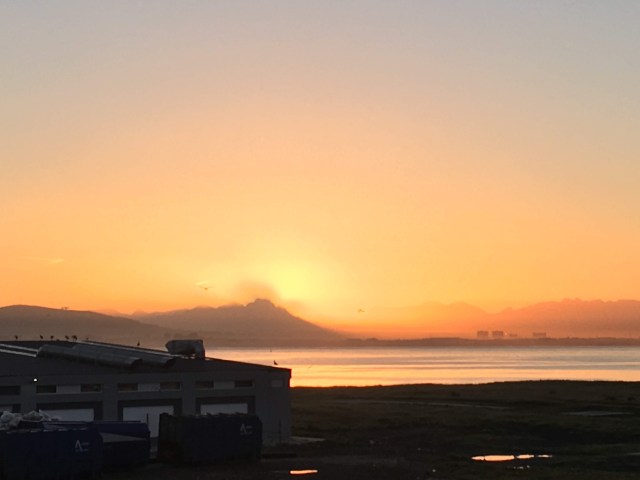
The marathon course started with a beautiful start running the first three miles with the Atlantic Ocean on your right side as the sun started to rise. The waves were large (6 to 8 feet) and crashing on the rocks the entire way. The course then turned up the hill towards Table Mountain as you ran downtown and traversed the base of the towering mountain on your right. The course ran through a very diverse city. Some areas where the poor lived in cardboard and corrugated metal shacks while other neighborhoods looked upper middle class in the US.
Some of the course ran through areas that are part of the re-building of the city. The area known as Woodstock has many new restaurants and stores located in renovated biscuit factory. Many areas, however, had buildings that were in disrepair and should have been condemned. The finish line was outside the stadium that hosted the 1991 World Cup Soccer and very close to the V & A Waterfront (Victoria and Albert) Project that has a huge shopping mall and at least both fine and fast food dining in what was the old harbor. A new larger harbor has been built right next door to the V&A and by the look at the number of freighters being unloaded with the large cranes is quite busy.


Everyone in Africa speaks two languages. English and the language of their tribe. There are 11 tribes in South Africa and some people spoke the language of other tribes if they were larger tribes or did business with people from other tribes. We heard statistics that are hearsay, but seemed reasonable, that country was comprised of 89% natives (member of tribes) or others (whites, mostly British and Dutch).
Everywhere we went there are pictures, busts and statues of the first black democratic president of Africa, Nelson Mandella. He was elected President shortly after the British Government gave Africa independence in 1991 and was President for 5 years. He started the transition to democracy after centuries of British Rule that separate the races not only on buses and restaurants, but neighborhoods as well. Mixed marriage was illegal and was strictly enforced. Special testing could help a person determine their race so that they could marry the person of their choice. Speaking of marriage: it is still ritual that a dowry of 11 cattle is paid to the father of the bride by the groom or his family. Even though the cattle are not delivered in person, the value is usually transacted in cash.
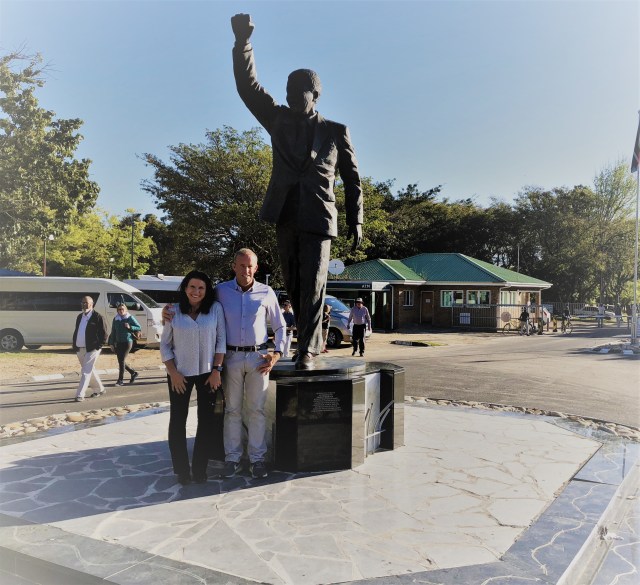
Nelson Mandella is idolized because even after spending decades in prison after being convicted of “Treason” because he organized protests of the existing government, the corruption and discrimination against the blacks in Africa and the obvious advantages towards the whites. However, it seems that President Mandela needed to stay in office for a second term to allow more time for the democracy to become more stabilized. Talking to the locals the corruption and graft within the government is rampant and a huge hinderance in making sure that equality for everyone is actually going to become a reality. They are now operating with an interim president because the past president was removed after a vote of “no confidence” last year. The past president is said to be in Dubai and so is all his money.
We did a lot more than just the marathon on the trip to South Africa. The first full day in Cape Town we went on a “Gin Tour”. I know…gonna run a marathon and going on Gin tour…Really! Out of the four gin mills we went to, the first one in Woodstock was in a place the size of a small New England diner. They make their gin using wine in the gin mill and experimented with different flavors before also making their own tonic water flavored to match the gin. Maria is trying to get him set up with Amazon.

The next day we did a City Tour that took us to many of the historical buildings in Cape Town as well as Table Mountain and then finally to pick up our race numbers at the Marathon Expo.
Saturday before the marathon we went on a wine tour to the Stellenbosch region and went to five different wineries that were spectacular in architecture and in the presentation of their wines. Unlike the Napa wineries that are very young some of these wineries were hundreds of years old.
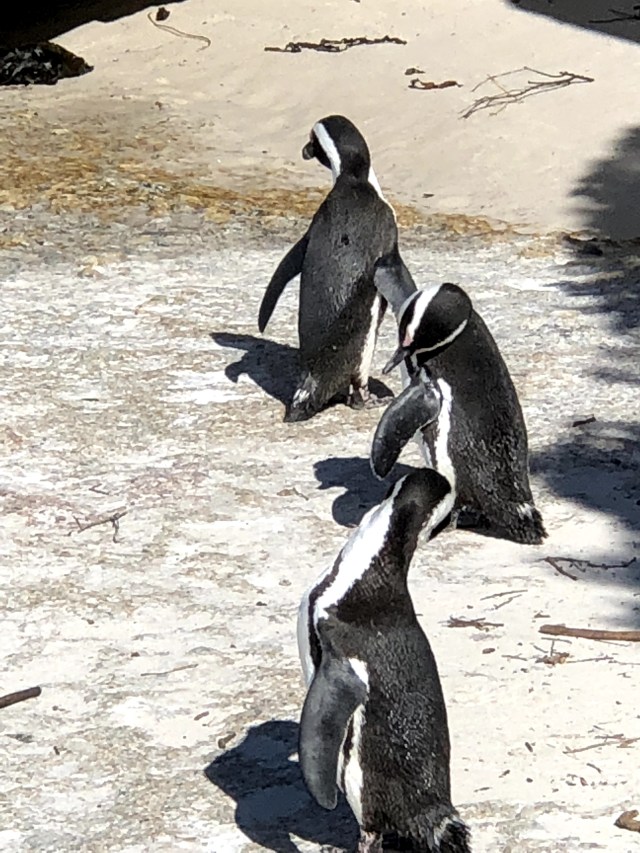
Sunday afternoon after the marathon we went on a tour to see the penguins (Maria wanted to see them more than the lions) and then on to the Cape of Good Hope where the Atlantic and the Indian Ocean meet.
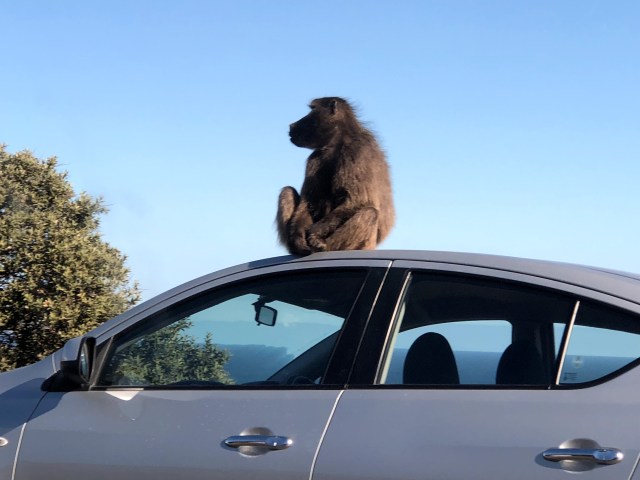
This also where we found out the baboons rule the roost. They are endangered and cannot be punished for stealing the food right out of people hands. There are many stories of people having ice creams taken out of their hands. Picnics are not a good idea in the national parks because the baboons are the only ones eating out of the picnic baskets.
The Monday after the marathon we flew from Cape Town to Port Elizabeth and then drove for an hour to Shamwari Game Preserve. The reserve was started in 1992 by Adrian Gardiner, a contractor who had a vision to put back the land back into its natural state. Not just with the animals, but they even brought in the insects that were native to the area before the over farming of the area just about made it a wasteland. He ended up with almost 100,000 acres and there are five lodges that go from smaller five room hotels to 30 room compounds with swimming pools and spas.
We settled into the lodge midafternoon and were offered “high tea” on the deck of the lodge and while we were waiting a monkey ran in one open door and loaded up on candies and sugar cubes and exited out the other open door. He then returned later and took a slice of bread right off my plate while I was looking the other way.
Each day we went on two “drives” that we were able to see animals in their natural habitat (Antelope, warthogs, monkeys, impalas, Kodu, elephants, rhinos, lions, tigers, cheetahs, and even hippopotamus). One day we went with two guides on a hike that allowed you to really see and smell how the animals lived. I could go on for hours about how the vision of one man has made such a difference in the area. He took wasteland and has restored it to its original condition, not just the land but the habitat. Even the “Dung Beetle” was brought in to complete the ecosystem to handle all the elephant dung.


The reserve employees hundreds of locals and since the reserve started the surrounding land has increased in value tenfold because the employees and contractors for the reserve are building houses and buy land for themselves.
We then flew to Johannesburg and did a whirlwind tour to see the Apartheid Museum and Nelson Mandella’s Museum that included his office prior to and after his presidency. We took a ride through the city that is 65% burned out or what they call “hijacked” buildings where the owner has abandoned the building and people occupy the buildings as squatters with no water, sewer, or electricity. They heat with small gas/petrol heaters that are causing fires because the bedding is mostly newspapers and cardboard. The buildings are not small, many were 15 to 20 story buildings.
South Africa has little to no manufacturing. There are gold and diamond mines that are a small part of the economy. The rest is agricultural (fruits, vegetables, and wine) and 55% is tourism.
The people we met were friendly and helpful and wanted to make sure that we understood the heritage and the country. South Africa was a great option to cross Continent #5 off the list! Stay tuned for the next adventure – Ghost Train Ultra Marathon later in October – and then we’ll see where we will be heading for Continent #6!
 ralphruns50